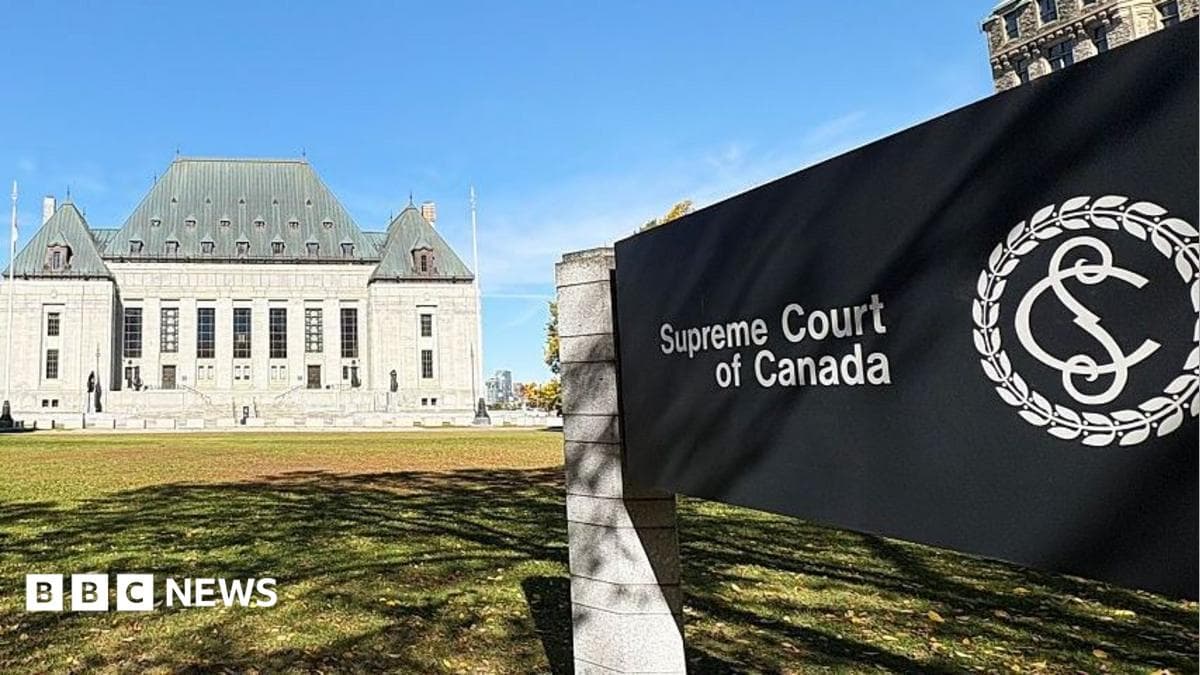
Canada's top court largely upholds Quebec ban on religious symbols for public servants
The law faced legal challenges from a range of groups, including female Muslim, Sikh and Catholic teachers, who argued it violated their funadamental rights.
Noticia publicada originalmente por BBC News — World en bbc.co.uk (se abre en una pestaña nueva). Minuto 24 no es autor de este contenido.
Claves de la noticia
- El Tribunal Supremo de Canadá confirmó en gran medida la validez de la ley 21 de Quebec, que prohíbe a los empleados del sector público llevar símbolos religiosos como el hiyab o la cruz.
- La corte señaló que la ley vulnera los derechos democráticos al prohibir a los cargos electos de Quebec llevar cubrebocas por motivos religiosos.
- El tribunal afirmó que un tribunal canadiense puede determinar si una ley es compatible con la Carta de Derechos y Libertades aunque se invoque la cláusula de no obstante, aunque no lo hizo en este caso.
- Tres de los siete magistrados discreparon en parte, al considerar que la ley infringe la libertad religiosa, la libertad de expresión y el derecho a la igualdad.
- El primer ministro Mark Carney afirmó que su gobierno estudiará las implicaciones del fallo.
Contexto
La ley 21 fue aprobada en Quebec en 2019 y se apoya en la cláusula de no obstante, un mecanismo de la Constitución canadiense que permite a los gobiernos anular ciertos derechos, como la libertad religiosa. Quebec defiende la norma como parte de su laicidad, o laïcité, que considera un elemento central de su identidad. Grupos de derechos civiles sostienen que afecta de forma desproporcionada a las mujeres musulmanas y las excluye de ámbitos clave de la vida pública. Además, la provincia aprobó recientemente normas que amplían la laicidad a guarderías subvencionadas e instituciones postsecundarias. El fallo es uno de los más seguidos en la historia judicial del país, por su impacto tanto en Quebec como en el resto de Canadá.
Resumen elaborado por Minuto 24 con ayuda de inteligencia artificial a partir de la noticia publicada por BBC News — World. Puede contener imprecisiones: ante cualquier duda, consulta la fuente original.
Published27 November 2026, 14:55 GMT
Canada's top court has largely upheld a Quebec law banning public sector workers from wearing religious symbols, including the hijab and the cross.
The law, known as Bill 21, faced legal challenges from a range of groups, including female Muslim, Sikh and Catholic teachers, who argued it violated their fundamental rights.
Quebec passed the law in 2019 under a unique fixture of Canada's constitution called the "notwithstanding clause" - a legal loophole that allows governments to override certain rights, like freedom of religion.
The Supreme Court's decision is one of the most closely watched in Canadian history, with an impact that will be felt both in Quebec and across the country.
Reacting to the ruling on CBC, Prime Minister Mark Carney said his government would study its implications, adding it was important for all legislatures "to respect the rights and liberties of all Canadians, including those in the minority."
The Supreme Court was asked to weigh in on a number of questions, including on the constitutionality of Bill 21, whether Quebec's use of the notwithstanding clause was appropriate, and whether there are limits to its use.
On Friday, the top court confirmed the validity of Bill 21, but ruled that the law infringes on democratic rights by banning Quebec's elected officials from wearing a face covering for religious reasons.
The court also ruled that a Canadian court has the power to declare whether a law is consistent with the Canadian Charter of Rights and Freedoms even if the notwithstanding clause is invoked, but that they would not do so in this case.
While the majority of the seven justices found that Quebec's law is largely valid, some dissented to parts of the decision.
Justices Andromache Karakatsanis, Michelle O'Bonsawin and Nicholas Kasirer wrote that the notwithstanding clause "cannot be used to authorize laws that are incompatible with the fundamental character of Canada as a free and democratic country".
Specifically, they said they believe the law infringes on the charter's guarantee to freedom of religion, freedom of expression and the right to equality.
Canada's top court to rule on Quebec's ban on wearing religious symbols
Civil liberty groups in Quebec have criticised Bill 21, saying it disproportionately affects Muslim women who wear the hijab, arguing that it has excluded them from key areas of public life in the province.
Stephen Brown, CEO of the National Council of Canadian Muslims, called the law "discriminatory" and criticised the court's decision.
"Entire categories of people are now barred from entire sectors of employment, not because of what they have done, but because of who they are," he said.
The chair of the English Montreal School Board, one of the main groups challenging the law, said the board was "obviously very disappointed" with the ruling.
"It wasn't the result we were looking for," Ortona told reporters. "But we do take solace from a lot of the declarations that were made by the court."
Quebec has argued that the law is necessary to uphold the province's state secularism - or laïcité - as a core component of its identity.
Earlier this year, the province passed another bill expanding its secularism rules to subsidised daycares and post-secondary institutions. It also restricted public prayer with fines for non-compliance.
The leader of the Bloc Québécois, a federal party that advocates for Quebec sovereignty, said Friday's ruling upheld the province's right to protect its values.
"We are now more than ever in a position to move forward with the preservation of the very elements that profoundly define the distinct nature of Quebec society," he told reporters in French.