Five new miniature frog species found in eastern Himalayas
Scientists say the frogs evolved as the Himalayas rose and the Asian monsoon took shape.
Noticia publicada originalmente por BBC News — World en bbc.co.uk (se abre en una pestaña nueva). Minuto 24 no es autor de este contenido.
Claves de la noticia
- Científicos descubrieron cinco nuevas especies de ranas cornudas diminutas en el Himalaya oriental de India, lo que más que duplica las especies conocidas del grupo.
- El equipo, formado por investigadores de la Universidad de Delhi y de la Universidad de Harvard, trabajó cinco años en el terreno e identificó las ranas como miembros del grupo Jingophrys.
- Una de las especies, Jingophrys tanogogo, es la primera rana conocida en India que se alimenta de caracoles y la primera de su familia registrada con esa dieta.
- Según el estudio, publicado el 11 de noviembre en la revista Royal Society Open Science, el Himalaya ha tenido un papel mucho mayor en la evolución de las ranas de lo que se pensaba.
- Los análisis de ADN indican que estas ranas se diversificaron rápidamente conforme subía la cordillera y se formaba el monzón asiático, y los investigadores destacan el apoyo esencial de comunidades locales.
Contexto
El Himalaya es una de las regiones con mayor biodiversidad del planeta, con paisajes que van desde bosques tropicales hasta prados alpinos. Aun así, muchas de sus zonas no han sido estudiadas a fondo, y el estado indio de Arunachal Pradesh figura entre los menos investigados. Por eso, los hallazgos sugieren que la región puede albergar una biodiversidad oculta importante. Las ranas cornudas son anfibios que suelen pasar desapercibidos, y algunas especies solo aparecen en bosques remotos durante una breve temporada de reproducción. Descubrir especies nuevas ayuda a entender cómo evolucionan los ecosistemas y qué necesitan para su conservación, una tarea que los investigadores consideran pendiente.
Resumen elaborado por Minuto 24 con ayuda de inteligencia artificial a partir de la noticia publicada por BBC News — World. Puede contener imprecisiones: ante cualquier duda, consulta la fuente original.
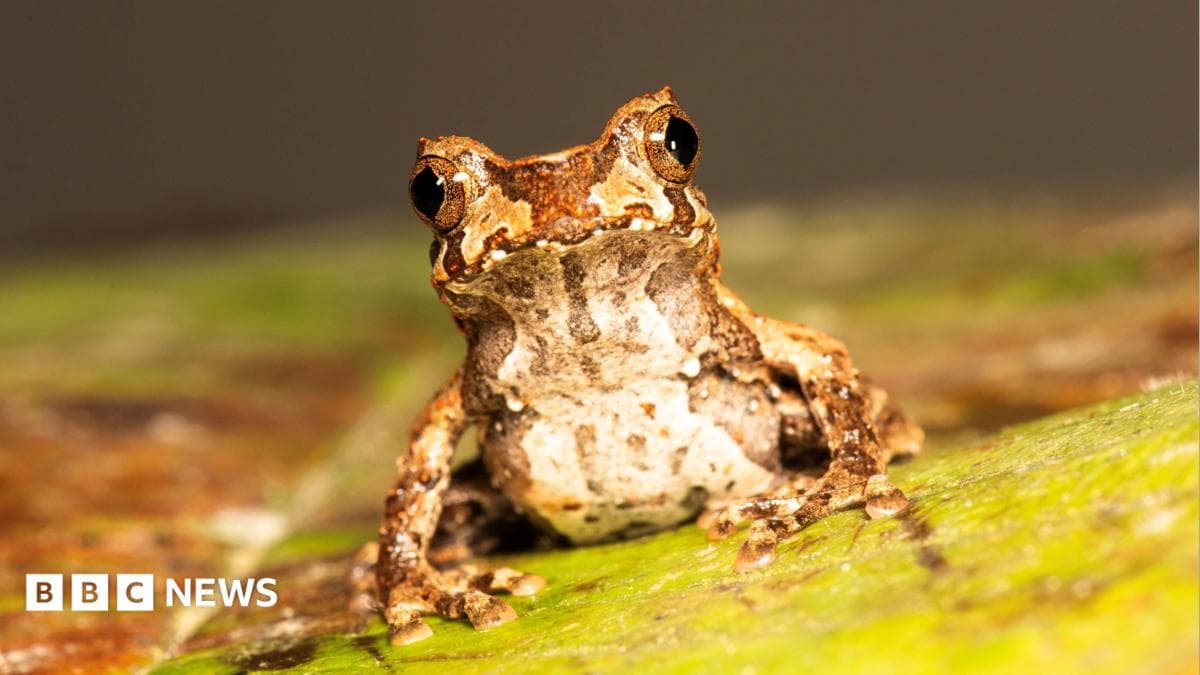
Scientists have discovered five new species of tiny horned frogs in India's eastern Himalayas, more than doubling the number of known species in the group.
A team of scientists from University of Delhi and Harvard University made the discoveries after five years of fieldwork, identifying the frogs as members of the Jingophrys group.
Among them is Jingophrys tanogogo - or the snail-eating horned frog - the first frog known in India to feed on snails and the first member of its family recorded with such a diet.
The research suggest the Himalayas have played a much larger role in frog evolution than previously thought and highlight the region as an overlooked hotspot for biodiversity.
The Himalayas, stretching from tropical forests to alpine meadows, are among the world's richest biodiversity regions.
Despite drawing interest from scientists and researchers, many parts here have not been fully explored.
The state of Arunachal Pradesh particularly has emerged as one of its least-studied regions.
Dr Sonali Garg, who led the study at Harvard University's Museum of Comparative Zoology, said the research highlights how significant evolutionary changes can go unnoticed in little-studied species.
The study - called two-fold hidden diversity of diminutive horned frogs (Megophryinae: Jingophrys) - was conducted by Garg along with her colleague James Hanken and Delhi University's SD Biju, Tage Tajo and Radhakrishna Upadhyaya K.
It was published on 11 November in the Royal Society Open Science journal.
"Some of the new species are extremely secretive and found in remote forests only during a short breeding season," says Biju.
Researchers say further studies will have to done to better understand their biology and conservation needs.
DNA analysis showed the horned frogs rapidly diversified into multiple species in the eastern Himalayas as the mountain range rose and the Asian monsoon took shape over millions of years, helping drive the evolution of the region's plants and wildlife.
The researchers said in a statement that local tribes gave them essential field support and knowledge that helped make the discoveries possible. Some of the species were named after these communities.
The Tanii horned frog (Jingophrys taniitatii), for instance, is named by combining the name of the Tanii tribe in the region with the word 'tatti' - frog in the local Apatani language.
The new species have been named Jingophrys taniitatii (Tanii horned frog), Jingophrys tanogogo (snail-eating horned frog), Jingophrys siangensis (Siang horned frog), Jingophrys hrdy (Hrdy's horned frog) and Jingophrys wularsoni (Wu-Larson's horned frog).