Has global jihadism failed, or is it simply changing shape?
Jihadist groups appear to be focusing on local issues rather than global terror. Does it signify a real change?
Noticia publicada originalmente por BBC News — World en bbc.co.uk (se abre en una pestaña nueva). Minuto 24 no es autor de este contenido.
Claves de la noticia
- Al-Shabab, la rama somalí de al-Qaeda, ha difundido en redes sociales y radio reparto de alimentos a familias necesitadas como parte de un esfuerzo por ganarse a las comunidades locales.
- El artículo sostiene que parte del yihadismo está dando prioridad a conquistar el poder en su propio país, con más disposición a pactar, en lugar de centrarse en atacar a Occidente.
- La rama sahelina de al-Qaeda, JNIM, se ha aliado con separatistas tuareg y ha suavizado su propaganda, presentándose como defensora de la población frente a gobiernos corruptos y abusivos.
- El líder sirio Ahmed al-Sharaa, antiguo comandante yihadista, llegó al poder en Syria en diciembre de 2024 y fue recibido por líderes occidentales, lo que genera debate entre los yihadistas.
- Según los expertos citados, el debate sobre si este cambio es real o solo táctico sigue abierto, y la historia sugiere que estos grupos pueden esperar el momento oportuno.
Contexto
El yihadismo global se originó con la red al-Qaeda, responsable de los atentados del 11 de septiembre de 2001 en Estados Unidos, y se expandió después con el Estado Islámico, que controló amplias zonas de Irak y Siria. Tras años de derrotas militares y presión internacional, sus objetivos de gobernar países según su interpretación estricta del islam siguen sin cumplirse. Por eso el debate sobre sus estrategias es relevante: si los grupos adoptan alianzas y concesiones, pueden ganar influencia sobre poblaciones locales y complicar la respuesta de los gobiernos y de la comunidad internacional, especialmente en África, que hoy es el principal escenario de estos conflictos.
Resumen elaborado por Minuto 24 con ayuda de inteligencia artificial a partir de la noticia publicada por BBC News — World. Puede contener imprecisiones: ante cualquier duda, consulta la fuente original.
Rice, pasta, sugar, cooking oil and beans are hardly what you'd expect to see in jihadist propaganda. Yet these were among the supplies that al-Qaeda's Somali branch, al-Shabab, said its "charity" had handed out to hundreds of struggling families in August, as it publicised the aid through its social media accounts and radio station.
The group, which controls large parts of rural southern and central Somalia, has been keen to show off its so-called humanitarian work throughout 2026.
"May God reward them," said a local woman in one of al-Shabab's videos.
It's all part of an effort to win over local communities and present itself as more than just a jihadist group.
A quarter of a century after al-Qaeda's 9/11 attacks in the US, and 12 years after Islamic State group (IS) declared its so-called caliphate in Iraq and Syria, the jihadist movement looks very different.
Rather than focusing on attacking the West or fighting for a global Islamic state, some - especially those linked to al-Qaeda - are putting more effort into winning power closer to home. And they seem increasingly willing to make compromises along the way.
Because of this, a debate is growing within the movement. While hardliners reject compromise, pragmatists see working with local groups and former enemies as a way to gain power. But do the pragmatists represent a genuine change or simply a shift in tactics to achieve the same ultimate goals: establishing a state that applies their strict interpretation of Islamic Sharia law both at home and in its dealings with the outside world?
Significant defeats
Neither al-Qaeda nor IS has achieved its ultimate dream: taking over one or more countries and ruling them according to their strict interpretation of Islam.
Both have suffered major defeats, lost leaders and faced years of international pressure. IS, which once controlled vast areas of Iraq and Syria, lost its last territorial stronghold in 2019. But jihadism hasn't gone away.
Africa is now the main battleground for jihadism, with al-Qaeda's powerful branches, JNIM in the Sahel (Mali, Burkina Faso and Niger) and al-Shabab in Somalia, fighting long-running insurgencies. IS, its bitter rival, has active branches in Nigeria, the Democratic Republic of Congo, the Sahel, Mozambique and Somalia.
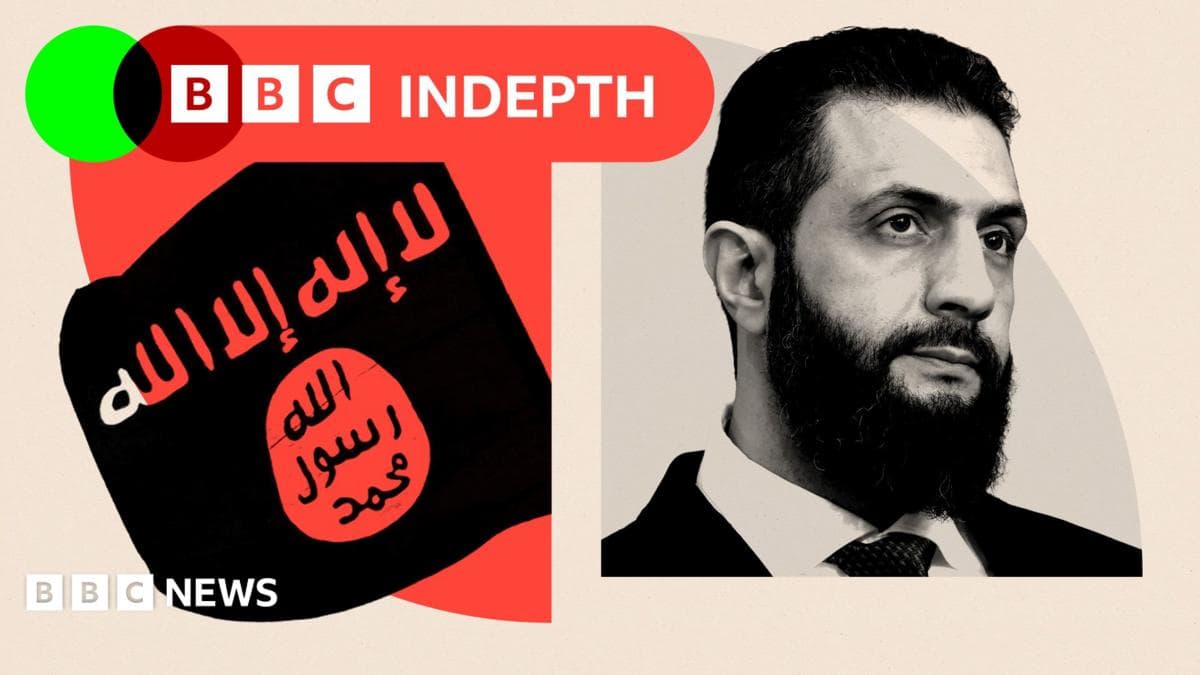
One major source of inspiration, and envy, whether jihadists admit it or not, is Syria's new president, Ahmed al-Sharaa. The former IS and then al-Qaeda commander was once wanted by the US but rose to power in Syria in December 2024 and was welcomed by Western leaders.
Once known by his militant nom de guerre Abu Mohammed al-Jolani, he led the jihadist group Nusra Front - initially linked to IS and then al-Qaeda - and later the group Hayat Tahrir al-Sham (HTS).
He gradually broke ties with both IS and al-Qaeda and distanced himself from their calls for global jihad.
Instead, he focused on Syria, building a local power base in the north-western Idlib province.
What surprised everyone was his growing willingness to work with non-Islamist groups and engage with foreign powers. As HTS advanced on Damascus, its leadership sought to reassure the international community, reaching out even to Russia, a key ally of then-president Bashar al-Assad, to allay fears of an Islamist takeover.
That pragmatism, combined with favourable geopolitical conditions - including a weaker Russia and Iran - helped him take power in Syria.
But the sight of him being welcomed by world leaders, including US President Donald Trump, was even more remarkable.
During Sharaa's visit to the White House in November 2025, Trump sprayed him with his own branded cologne, jokingly asked how many wives he had and praised him as a "very strong leader".
For some jihadists, Sharaa's success has been inspiring. Others, however, see his actions as a betrayal of everything they believe in.
IS has declared jihad against Syria's new Islamist government, branding Sharaa and his officials "apostates", and has carried out attacks against government forces on that basis. Other hardline clerics have taken a similar stance, but have stopped short of openly calling for jihad against Sharaa.
The divide between hardline jihadists and their more pragmatic counterparts has fuelled a bitter online debate since 2025, with rival voices trading accusations of betrayal and even publishing competing books to defend their positions.
For hardliners, going too far can mean abandoning their core beliefs. This might include holding back from imposing their strict version of Islamic law, accepting "man-made" laws or a constitution, taking part in elections, working with non-Islamist groups, or building ties with governments they consider "infidel".
Another source of inspiration for jihadists was the Taliban's return to power in Afghanistan in 2021, as it showed that an Islamist movement could eventually take control of a country after years of fighting Western-backed forces. It engaged local groups, slowly secured power across the country, used international diplomacy, and bided its time before taking the capital, Kabul, in a lightning offensive.
A means to an end?
Two groups are especially worth watching: al-Qaeda's branches in Mali and Somalia.
In late April, al-Qaeda's Sahel branch, known as JNIM, showed considerable pragmatism by joining forces with nationalist Tuareg separatists - whom it had occasionally fought - to launch a major offensive that threatened Mali's military rulers. It even went as far as to call the Tuaregs "brothers".
But it's not just JNIM's growing military strength that's attracting attention. It's also how the group is presenting itself.
Its propaganda once prominently featured al-Qaeda's leaders, slogans and calls for global jihad. Since late 2024, however, its videos have dropped the familiar al-Qaeda branding.
And instead of talking about global Muslim causes, JNIM has increasingly focused on local problems, portraying itself as a defender of ordinary people against corrupt and abusive rulers.
It has repeatedly accused Mali's military government and its Russian allies of killing civilians and making people's lives worse.
In April, it appealed to "all sincere patriots" to help build a "new Mali", promising security, justice and prosperity alongside Islamic law.
It has even suggested it could have "balanced relations" with Russia, despite the fact they're fighting Russian forces backing Mali's government. Its wording echoed that of HTS to Russia as it advanced on Damascus.
There are parallels with Sharaa's approach in Syria: build local alliances, reassure potential enemies and avoid giving outside powers a reason to intervene.
Africa security specialist Aman Bezreh sees similarities between the two groups, but says JNIM's shift may take time.
"JNIM has indeed shown signs of pragmatism similar to HTS", she says. "However, its rebranding has progressed more slowly because the group is simultaneously focused on expanding into new territories and recruiting from diverse pools."
Taliban v Sharaa
The debate over which path to follow is also taking place within JNIM's leadership, according to Wassim Nasr, a France 24 journalist and jihadism expert.
He says one camp favours the Taliban's approach of taking power through force with minimal concessions. The other, which he says currently has the upper hand, favours an approach closer to that of Syria's HTS - making compromises and building wider alliances to gain power more quickly.
Nasr believes JNIM may borrow from both models, but that a break with al-Qaeda is inevitable as a result of its political evolution.
Like JNIM, al-Shabab in Somalia appears willing to make deals with former enemies.
According to Abdullahi Guji, BBC Monitoring's Somalia specialist, al-Shabab reached a truce in October with a powerful Somali tribe, the Ma'awisley, whose fighters had been at the forefront of the fight against the group.
The tribe has since withdrawn its fighters from the front line, dealing a serious blow to the government's campaign against jihadists, says Guji.
Guji believes the group may soon have a chance to test whether it can seize power and establish itself as an alternative government across wider parts of the country.
African Union forces are withdrawing from Somalia amid funding cuts and the approaching end of their mandate in December. Meanwhile, the Somali government is facing political crises and rebellions, creating vulnerabilities al-Shabab could exploit, he adds.
There's another reason some jihadists may see an opportunity to expand: they believe Western governments have bigger fish to fry.
With the war in Ukraine, US-Iran conflict in the Middle East and growing rivalries with China and Russia, fighting jihadists is no longer the priority it was after 9/11.
The US withdrawal from Afghanistan in 2021 and the Taliban's return to power, followed by Sharaa's rise in Syria, have reinforced that belief.
Colin Clarke, executive director of the Soufan Center, a non-profit research group that focuses on security, says some jihadist groups have learnt that avoiding confrontation with the US can help them escape Western military action and "live to fight another day".
That doesn't mean the West has stopped fighting terrorism. But if jihadists believe it is distracted or less willing to intervene, they may feel emboldened to pursue power.
History lessons
Unlike its fiercely uncompromising rival IS, al-Qaeda has long shown some flexibility in pursuing its goals. But history offers a warning.
After the 2011 Arab uprisings, which largely sidelined al-Qaeda, affiliated jihadist groups in Yemen, Libya and Tunisia began using the name Ansar al-Sharia (Supporters of Sharia) to win local support without carrying the al-Qaeda brand.
In Mali in 2012, al-Qaeda leaders advised jihadists who had seized the north alongside Tuareg separatists not to rush into imposing strict Islamic rules. Instead, they urged them to work with local allies, avoid alienating communities and play down their al-Qaeda links.
The message wasn't to give up their ambitions. It was to show strategic patience until the time was right. That same thinking could be at work today.