In a year of AI solving maths problems, Anthropic may have just solved the biggest
A mathematician at Anthropic says he used an AI to prove the famed Riemann hypothesis, though verification will take some time.
Noticia publicada originalmente por BBC News — World en bbc.co.uk (se abre en una pestaña nueva). Minuto 24 no es autor de este contenido.
Claves de la noticia
- Levent Alpöge, matemático que trabaja en Anthropic, afirma haber usado el chatbot Claude para elaborar una demostración de la hipótesis de Riemann.
- Según el artículo, la demostración se hizo a lo largo de unas seis semanas con una versión no pública de Claude y se anunció un día después del debut bursátil de Anthropic.
- La demostración, escrita en el lenguaje Lean, supera las 250.000 líneas, y el matemático Terence Tao afirma que su verificación aún tardará.
- La hipótesis de Riemann, planteada hace cerca de 170 años, trata sobre el orden de los números primos y se considera el problema más famoso de las matemáticas.
- Varias empresas de IA, como OpenAI, han anunciado soluciones a problemas matemáticos, pero un grupo de académicos criticó esas afirmaciones y su verificación sigue pendiente.
Contexto
La hipótesis de Riemann es una conjetura formulada por el matemático Bernhard Riemann que se refiere a la distribución de los números primos, piezas básicas de las matemáticas superiores. Su posible resolución tendría un enorme impacto en el campo, por lo que cualquier afirmación al respecto exige una revisión rigurosa por parte de expertos independientes. El caso se enmarca en una tendencia reciente en la que empresas de inteligencia artificial anuncian avances en problemas matemáticos antes sin resolver. Ese contexto ha generado debate en la comunidad científica sobre la fiabilidad de estas afirmaciones y sobre el papel de la IA en la investigación. Según la fuente, la verificación de esta demostración aún llevará tiempo.
Resumen elaborado por Minuto 24 con ayuda de inteligencia artificial a partir de la noticia publicada por BBC News — World. Puede contener imprecisiones: ante cualquier duda, consulta la fuente original.
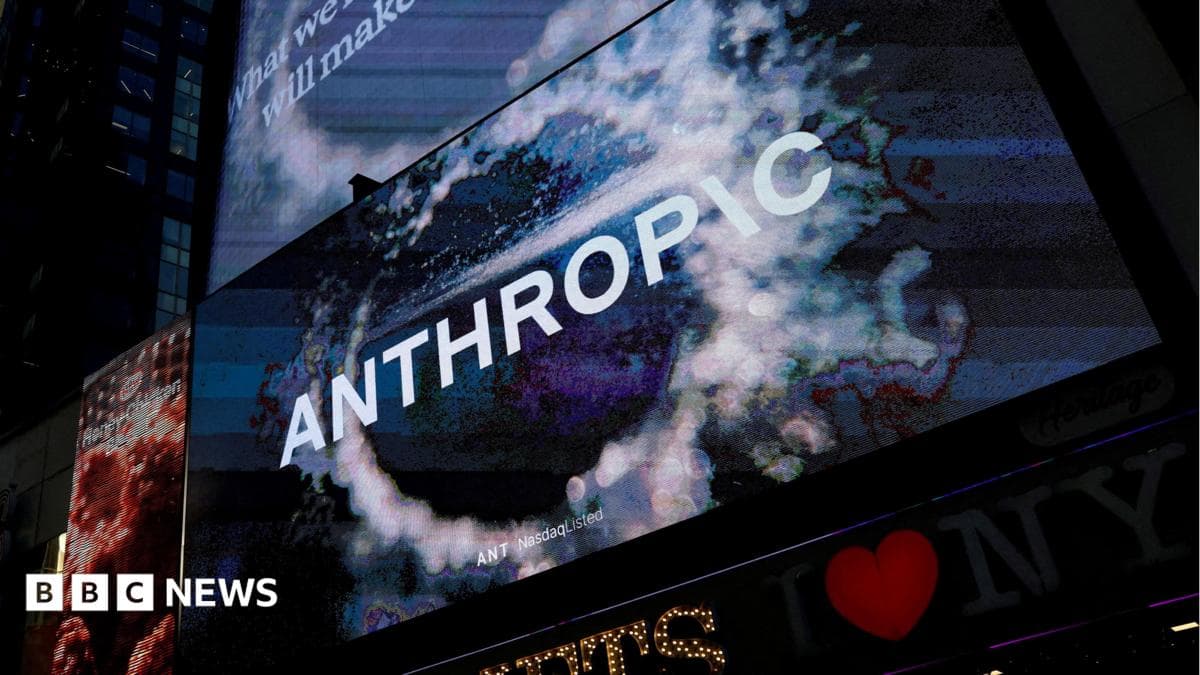
An Anthropic employee and mathematician claims to have used the company's artificial intelligence (AI) chatbot to prove the famed Riemann hypothesis.
Levent Alpöge said, external on Friday, a day after Anthropic made its US stock market debut, that over the course of about six weeks, he used the Claude chatbot to create a detailed proof of the maths problem.
If found to be correct, the proof would be among the most significant in history. Alpöge described it as "one dawn across science of something far greater".
The claim comes as AI firms like OpenAI have in recent months announced scores of solutions to major higher maths problems that have eluded scholars for decades.
As for the Riemann hypothesis proof put forward on Friday, it was found using a non-public version of Anthropic's Claude.
It is a nearly 170-year-old maths problem that deals with prime numbers and is widely considered to be the single most famous problem in maths, in large part due to how complex it is.
Named for the mathematician Bernhard Riemann, the hypothesis puts forward that prime numbers have a determined order along the number line.
Prime numbers are the bedrock of higher maths, leaving breakthroughs related to them to have broad impact.
Alpöge said that he messaged Anthropic CEO Dario Amodei on Sunday, asking him directly about how he could announce the discovery.
"The precise timing is horrible," Alpöge said, referring to Anthropic's public stock listing. "If I could have, I'd have finished this all much earlier."
"I am clearly unilaterally responsible for feeling I just could not live if I waited even longer. There is an obvious cynical view, to do with the timing, but it is false," he added.
The complete proof that Alpöge put forward in Lean, a computer language used for confirming maths proofs, is over 250,000 lines long.
Terrance Tao, a prominent mathematician, said on Friday, external that verification of the proof is still some way off.
"I imagine the digestion process will take some time, though in this case at least we have a human author to communicate with to assist with this task," Tao said.
No such human was obviously a part of major maths proofs made earlier this year using AI.
OpenAI in September claimed that employees using a non-public version of its AI tools were able to solve part of a notoriously difficult problem in just 88 hours. The problem was part of the Navier-Stokes equations, which concern how fluids move.
More than 10,000 AI agents, or computer programmed bots that operate somewhat autonomously, were put to the task as an AI training exercise.
The proof that OpenAI released on Navier-Stokes has yet to be confirmed as accurate, and it set off criticism within academic and higher maths communities and organisations about the use of AI to solve maths problems.
Anthropic has also claimed to have made other progress and solutions in maths, external and physics, external.
A group of maths scholars said, external AI companies boasting of major solutions to show how sophisticated their commercial products had become was "detrimental to the science of mathematics".
"We are witnessing a general threat to intellectual work, with misalignment between the outcome of the use of AI and its initial purpose," the scholars said in a group letter.
A month later, OpenAI released, external what it claimed were solutions, proofs, or major progress on 372 more outstanding higher maths problems.
It will take months, if not longer, for those claims to be reviewed by experts to prove their validity.