Israeli leadership rivals to hold critical talks to break election deadlock
Caretaker Prime Minister Benjamin Netanyahu will meet Gadi Eisenkot, who has a week to form an administration.
Noticia publicada originalmente por BBC News — World en bbc.co.uk (se abre en una pestaña nueva). Minuto 24 no es autor de este contenido.
Claves de la noticia
- El primer ministro en funciones de Israel, Benjamin Netanyahu, se reúne el domingo con el líder de la oposición, Gadi Eisenkot, para desbloquear el empate tras las elecciones de octubre.
- Netanyahu dijo que aceptaría que Eisenkot fuera primer ministro primero, dentro de un gobierno de unidad nacional con turnos en el cargo.
- Ninguno de los dos bloques alcanzó la mayoría de 61 escaños en la Knesset de 120: la oposición obtuvo 48 y el bloque de Netanyahu 53.
- Eisenkot tiene hasta el 6 de diciembre para formar gobierno, y Eisenkot pidió negociaciones «genuinas y aceleradas», aunque aún no ha recibido respuesta a su propuesta detallada.
- Los dos partidos árabes obtuvieron 19 escaños, lo que los convierte en posibles árbitros, aunque casi todos los partidos judíos se comprometieron a no gobernar con ellos.
Contexto
Israel celebra elecciones para la Knesset, el parlamento unicameral de 120 escaños, y ningún partido ha logrado nunca una mayoría absoluta, por lo que el país siempre ha sido gobernado por coaliciones. Esa necesidad de pactar se ha vuelto especialmente intensa en los últimos años, marcados por una gran fragmentación política y varias elecciones seguidas sin un gobierno estable. Netanyahu, líder del Likud, ha dominado buena parte de ese período, mientras que Eisenkot, exjefe del Ejército, encabeza la oposición de centro. El resultado actual deja en manos de partidos árabes y de pequeñas formaciones el equilibrio de poder, lo que convierte estas conversaciones en un punto decisivo para saber quién podrá formar gobierno.
Resumen elaborado por Minuto 24 con ayuda de inteligencia artificial a partir de la noticia publicada por BBC News — World. Puede contener imprecisiones: ante cualquier duda, consulta la fuente original.
Published28 November 2026
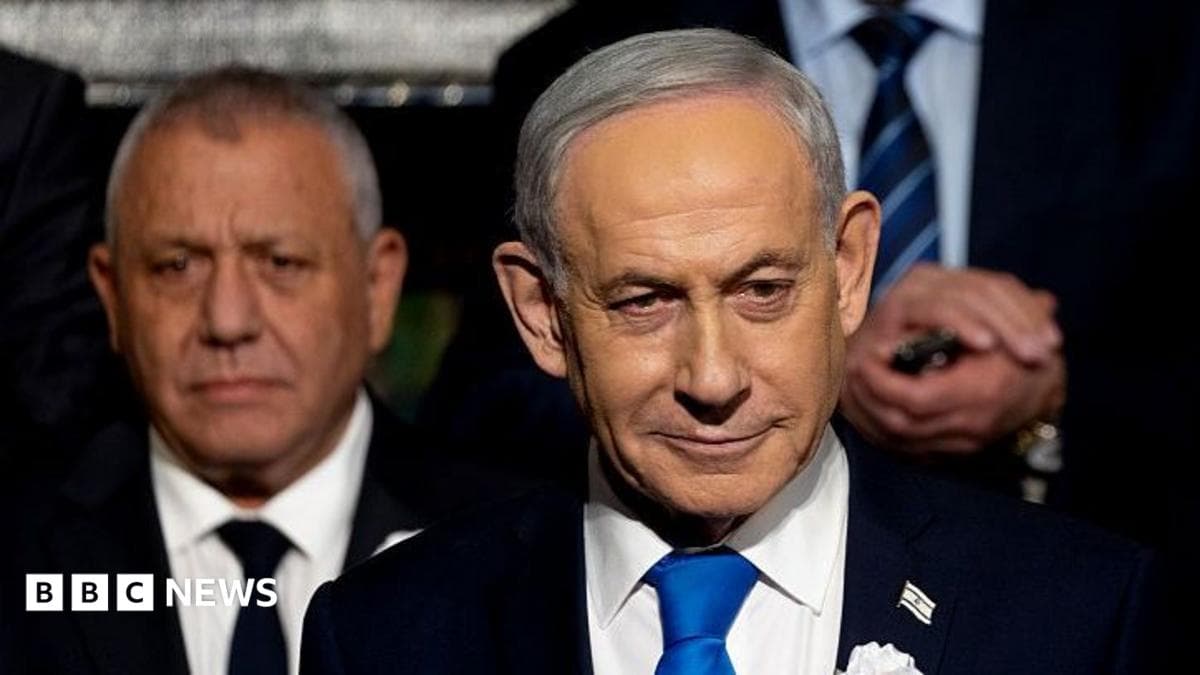
Israel's caretaker Prime Minister Benjamin Netanyahu is due to meet opposition leader Gadi Eisenkot on Sunday morning for talks to resolve the deadlock created by last month's election.
On Saturday, Netanyahu said he would agree to Eisenkot becoming prime minister first as part of a rotating national unity government.
Eisenkot's centrist Yashar party and three other Jewish opposition parties won 48 seats in October's election. Netanyahu's bloc won 53, with both short of a majority in the 120-seat Knesset.
Eisenkot has a week before a deadline elapses for him to form an administration on 6 December.
In a social media post on Saturday, Netanyahu said "my responsibility as a leader obligates me to put everything aside, including the principle of the largest party", adding he would initially serve as an "alternate prime minister".
Eisenkot, a former army chief, swiftly responded by inviting caretaker Prime Minister Netanyahu to "genuine and accelerated negotiations".
It comes after Eisenkot accused Netanyahu's right-wing Likud party on Friday of stalling coalition talks.
Israel's President Isaac Herzog said he consulted all parties during the week after the election before he gave Eisenkot 28 days to form a government.
Two Arab-led alliances, the United Arab List and the Joint List, together won an unprecedented 19 seats following a surge in turnout among Arab voters.
That has positioned them as potential kingmakers, however, all but one of the Jewish parties pledged before the polls not to work with them to form a government.
In an interview with Israel's Channel 12 on Saturday, the leader of moderate Islamist Raam party Mansour Abbas suggested that he and his party recognised Hamas as a "terror group". He confirmed he had voted for a bill Raam had co-sponsored which had included the designation. Such a move could pave the way for his party to join a coalition to unseat Netanyahu.
Eisenkot has made some progress towards achieving the majority he needs, agreeing coalition deals with the Yisrael Beiteinu party and The Democrats.
The fourth member of his bloc, the Beyachad party, is led by former Israel Prime Minister Naftali Bennett, who said on Thursday that he was in favour of a unity government involving Likud, with Eisenkot serving first as PM.
After Netanyahu's comments on Sunday, Bennett said Netanyahu had made the right decision in being "willing to join a unity government led by Eisenkot, a government based on an alliance of those who serve".
Netanyahu said he was making the proposal of a unity government because of "the magnitude of the existential danger and the possibility that a government will be formed that does not have the capacity to deal with this danger".
"If Likud is ready for genuine unity, I am ready to assess the seriousness of its intentions over the next 24 hours," Eisenkot said in response.
Yashar's leader said negotiations would be on the "detailed proposal" sent to Netanyahu last Sunday. Eisenkot added that "to this very moment, we have received no response".
On Friday, Eisenkot accused Likud of "stalling" and claimed the party had not put forward any concrete proposals over the past two weeks.
He went on to ask if Likud was serious about negotiations - with Netanyahu's offer coming hours later on Saturday.
No political party in Israel has ever won an outright majority, meaning all governments have been coalitions.
In the period 2019 to 2022, one of the most politically fractured in Israeli politics, there were five separate elections as Netanyahu and his rivals struggled time and again to co-operate.