Israeli military launches rare ground operation in Gaza beyond Yellow Line
Hamas condemns the incursion, which the Israeli military says is dismantling a "terror tunnel", as a "flagrant" ceasefire violation.
Noticia publicada originalmente por BBC News — World en bbc.co.uk (se abre en una pestaña nueva). Minuto 24 no es autor de este contenido.
Claves de la noticia
- Fuerzas terrestres israelíes lanzaron una operación poco común en una parte del centro de Gaza que está fuera de su control, tras emitir órdenes de evacuación para los residentes.
- Según testigos, los tanques avanzaron al este del campamento de refugiados de Nuseirat y llegaron a la carretera principal norte-sur del territorio, bajo cobertura de artillería.
- El ejército israelí afirma que la acción busca desmantelar un túnel que considera una amenaza, situado al oeste de la llamada Línea Amarilla; Hamás lo calificó de violación flagrante del alto el fuego.
- Las autoridades de Gaza informaron de tres personas muertas en ataques de drones israelíes del mismo día, mientras que el ejército dijo que solo reconocía dos de ellos.
- Desde el inicio del alto el fuego, al menos 1.658 personas han muerto en ataques israelíes, según el Ministerio de Salud de Gaza, cuyas cifras la ONU considera fiables.
Contexto
La Línea Amarilla es la frontera de facto que delimita la zona de Gaza controlada por Israel, que según el artículo abarca más del 60 % del territorio. Un movimiento de tropas más allá de esa línea pone en cuestión el alto el fuego de octubre de 2025, que es la base del plan de paz impulsado por Estados Unidos. Ese plan se encuentra en gran medida estancado, sobre todo por el desarme de Hamás, condición que Israel exige antes de cualquier retirada. La población civil es la más afectada: más de 1,9 millones de personas siguen desplazadas y la reconstrucción aún no ha comenzado. La guerra se inició tras el ataque de Hamás contra el sur de Israel en octubre de 2023.
Resumen elaborado por Minuto 24 con ayuda de inteligencia artificial a partir de la noticia publicada por BBC News — World. Puede contener imprecisiones: ante cualquier duda, consulta la fuente original.
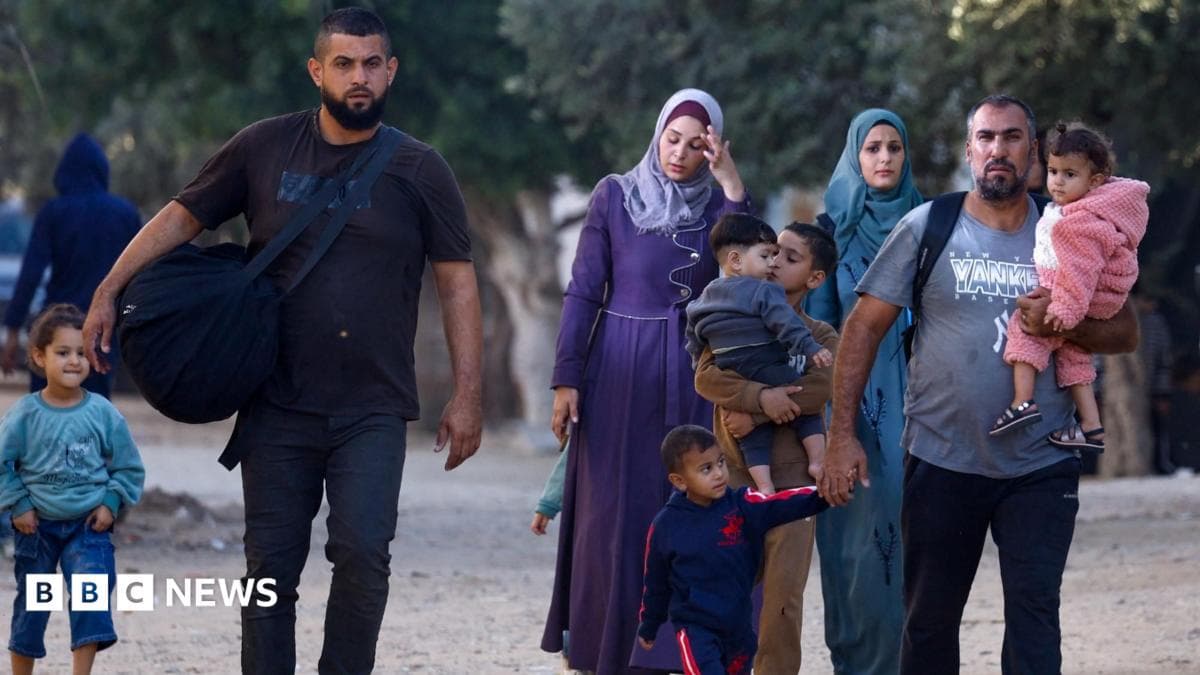
Israeli ground forces have launched a rare operation in part of the central Gaza Strip outside their control, after issuing evacuation orders for residents.
Witnesses said tanks advanced east of Nuseirat refugee camp and rolled onto the territory's main north to south road under the cover of artillery strikes.
The Israeli military said the "targeted" operation aimed to dismantle a "terror tunnel" west of the so-called Yellow Line, which marks the more than 60% of Gaza's territory occupied by Israel.
The Palestinian armed group Hamas, which controls the rest of Gaza, accused Israel of a "flagrant violation" of the October 2025 ceasefire agreement.
Violence has continued in Gaza over the past 13 months, with near-daily Israeli strikes, and living conditions for the 2.1 million people there remain dire.
Early on Wednesday afternoon, Israeli military body Cogat's Arabic spokesperson announced the start of the incursion and warned Palestinians living in an area north of Nuseirat and Bureij refugee camp to stay away for their own safety.
It also said a section of the north to south Salah al-Din road that passed through the area would be closed to traffic.
Later, the Israel Defense Forces (IDF) said it had begun a joint operation with the Shin Bet security service "to dismantle a terror tunnel west of the Yellow Line that posed an immediate and direct threat to IDF troops".
"IDF troops under the Southern Command are deployed in the area in accordance with the ceasefire agreement and will continue to operate to remove any immediate threat and thwart attempts by the Hamas terrorist organisation to harm Israeli civilians or IDF troops, or to violate the agreement," it added.
Hamas warned in a statement that the advance of Israeli military vehicles beyond the Yellow Line and the evacuation of residents constituted "a dangerous development and a flagrant violation of the ceasefire agreement".
Footage published by Palestinian media outlets and on social media showed families fleeing areas near Nuseirat camp following the announcement.
In one video verified by BBC Verify, a man can be seen ducking after hearing artillery fire and then running along Salah al-Din road, about 1.5km (0.9 miles) west of the Yellow Line. "The Israeli occupation now is firing randomly near the houses and tents of people," he says.
Automatic gunfire can be heard in another video filmed just to the south-east.
A resident of Nuseirat who was forced to flee told BBC Arabic's Middle East Daily programme: "The situation is now extremely dire, with Israeli forces firing indiscriminately at areas where displaced people have sought shelter."
"We couldn't take any of our belongings with us - not even our blankets, pillows, or clothes. We had no choice but to leave everything behind."
A second resident also reported "indiscriminate gunfire and shelling" and said there had been "numerous casualties, including fatalities".
Asked about reported fatalities, the IDF sent a general statement about the operation.
Israel building new land barriers in Gaza and displacing families
Israel moves Yellow Line deeper into Gaza, satellite images show
Gaza's Hamas-run Civil Defence agency said three people were killed and others were wounded in three separate Israeli drone strikes on Wednesday.
One man was killed in Nuseirat, the second to the north in Gaza City, and the third in the central town of Deir al-Balah, it added.
The Israeli military said the first two strikes targeted "terrorists" and that it was not aware of the third incident, according to AFP news agency.
At least 1,658 people have been killed in Israeli attacks in Gaza since the ceasefire began last year, according to the territory's Hamas-run health ministry, whose figures are considered reliable by the UN.
The Israeli military says six of its soldiers have been killed over the same period.
Meanwhile, more than 1.9 million people - about 90% of Gaza's population - remain displaced, with 1.4 million of them living in tents or makeshift shelters, according to the UN.
Reconstruction has yet to begin in Gaza, where an estimated 82% of all structures have been destroyed or damaged during the war, as US President Donald Trump's peace plan has largely stalled.
The disarmament of Hamas has been a key sticking point.
The group has agreed to give up its weapons in exchange for a phased withdrawal of Israeli troops from the 60% of Gaza they currently occupy. But Israel has insisted that Hamas must fully disarm before any pullout.
The war was triggered by the Hamas-led attack on southern Israel on 7 October 2023, when about 1,200 people were killed and 251 others were taken hostage.
Since then, more than 74,700 people have been killed in Gaza, the health ministry says.