Spanish PM and rivals rally supporters in final pitch for votes
Prime Minister Pedro Sánchez wants to defy the polls, and his main rivals accuse him of not telling the truth and of "betrayal".
Noticia publicada originalmente por BBC News — World en bbc.co.uk (se abre en una pestaña nueva). Minuto 24 no es autor de este contenido.
Claves de la noticia
- Pedro Sánchez, del Partido Socialista, dice confiar en superar las encuestas antes de las elecciones del domingo y acusa a Alberto Núñez Feijóo de planear una coalición con la extrema derecha.
- Feijóo, del Partido Popular, aparece ligeramente por delante en los sondeos y prometió una nueva era de "verdad, decencia y buen gobierno" en sus últimos actos en Barcelona y Sevilla.
- Vox, liderado por Santiago Abascal, cerró su campaña en Valencia con un mitin multitudinario y busca casi duplicar sus 33 escaños actuales.
- El último debate televisivo a cuatro bandas dejó clara la polarización: todos propusieron soluciones para la vivienda, pero el choque se centró en un gesto de Feijóo hacia Ada Colau.
Contexto
Spain celebra elecciones generales con unos 39 millones de votantes llamados a las urnas, y los sondeos anticipan un resultado muy ajustado. Sánchez gobierna con los socialistas, una de las pocas fuerzas de izquierda que aún dirigen un gobierno en Europa, mientras que el auge de partidos conservadores y de derecha radical en el continente sigue marcando el debate político. El país tiene además una cuestión histórica sensible: el franquismo y la transición a la democracia, mencionada en el mitin de Vox. Las comunidades de Andalucía, Extremadura, Aragón y Castilla y León son gobernadas por coaliciones del PP con Vox, lo que hace que el resultado nacional sea observado de cerca tanto dentro como fuera del país.
Resumen elaborado por Minuto 24 con ayuda de inteligencia artificial a partir de la noticia publicada por BBC News — World. Puede contener imprecisiones: ante cualquier duda, consulta la fuente original.
Published27 November 2026, 20:09 GMT
Spain's main party leaders have held their final rallies ahead of Sunday's election, with Socialist Prime Minister Pedro Sánchez saying he is confident of defying the polls.
"I cannot imagine us losing," he said, posing for selfies with supporters in red T-shirts and accusing conservative rival Alberto Núñez Feijóo of planning a coalition with the far right.
Feijóo's People's Party (PP) is narrowly ahead in the polls, and in the final hours of the campaign he travelled first to Barcelona and then Seville, promising voters a new political era of "truth, decency and good governance".
He accused Sánchez of evading questions on key issues like corruption, rail disasters, immigration and the national debt.
The Socialist leader heads one of Europe's few left-wing governments, and with the French presidential elections five months away, there is a real chance that two of the continent's biggest economies could move to the right in quick succession.
Almost 39 million people have a vote in Spain and while commentators expect a high turnout, most polls have suggested a close finish. Under Spanish electoral law, no polls have been published since Monday.
"This time, yes, we're going to do it," Feijóo told PP supporters, in a nod to his failure to form a government three years ago despite winning most seats.
If he gets to form a government this time, it will be with the support of anti-immigration party Vox, led by Santiago Abascal, whose final rally took place in front of thousands of people in a bull-ring in Valencia on Spain's east coast.
The venue was filled with Spanish flags and green Vox banners.
One of the biggest cheers of the night came when the secretary general of the party called for "less burka and less halal".
Ignacio Garriga said he was not acting out of hatred but love for the homeland.
We heard a small section of the crowd chant "Viva Franco" in reference to the dictator, whose death in 1975 heralded the start of Spain's transition to democracy.
A number of first-time voters at the rally said they were supporting Vox because of its policies on immigration.
Lledó, 18, said what had happened in Ceuta in the summer, when more than 70,000 migrants crossed into the Spanish territory from Morocco, showed that Sánchez was not able to control the country's border.
She had come to the bullring with her mum and aunt, Carli Chilet, who argued that Vox a"re the best for women's rights".
Vox is hoping to almost double its seats from the 33 it won three years ago. It backs policies such as "national priority" - putting Spanish citizens first for welfare - and "remigration" for foreigners not considered to be contributing to the economy.
Leaders clash in final Spain election debate as housing dominates run-in
Spanish election: What you need to know and what's at stake
Who to watch in Spain's election race
Clashing political visions reflect a divided Spain ahead of election
The final day of campaigning was very much in the shadow of a four-way TV debate the night before that exposed Spain's sharply polarised politics.
All four leaders had solutions for the housing crisis. Feijóo said the PP would build a million homes over four years, while Sánchez said housing should be a right not an object of speculation and profit.
While the conservatives tried to turn the spotlight on the series of scandals that have overshadowed the Socialists' term in office, Sánchez and his left-wing ally Ada Colau, who heads Frente Amplio (The Broad Front), focused on women's rights.
The two leaders seized on a moment in the debate when the PP leader accused Colau and the rest of the left of staying quiet during a flood disaster in Valencia, briefly moving his finger to his lips. The word he used "calladita" is a diminutive and can also be used to tell a woman to "keep quiet" in a condescending manner.
Sánchez reacted immediately and called on him to show "a little respect", accusing him of sexism.
Feijóo sought to clarify what he meant on Friday, and accused Ada Colau of remaining silent during "these years of corruption". His decision to wind up his campaign in Seville was significant, because the wider southern region of Andalusia has 61 seats in Spain's 350-seat parliament, more than any other.
Andalusia is also important because it is run by a coalition made up of the PP and Abascal's Vox, as are three other regions, Extremadura, Aragón, and Castilla y León.
Feijóo has insisted he wants to govern with a majority, backed up by "parliamentary support agreements" with Vox and says he has never spoken to Abascal about giving Vox ministerial power.
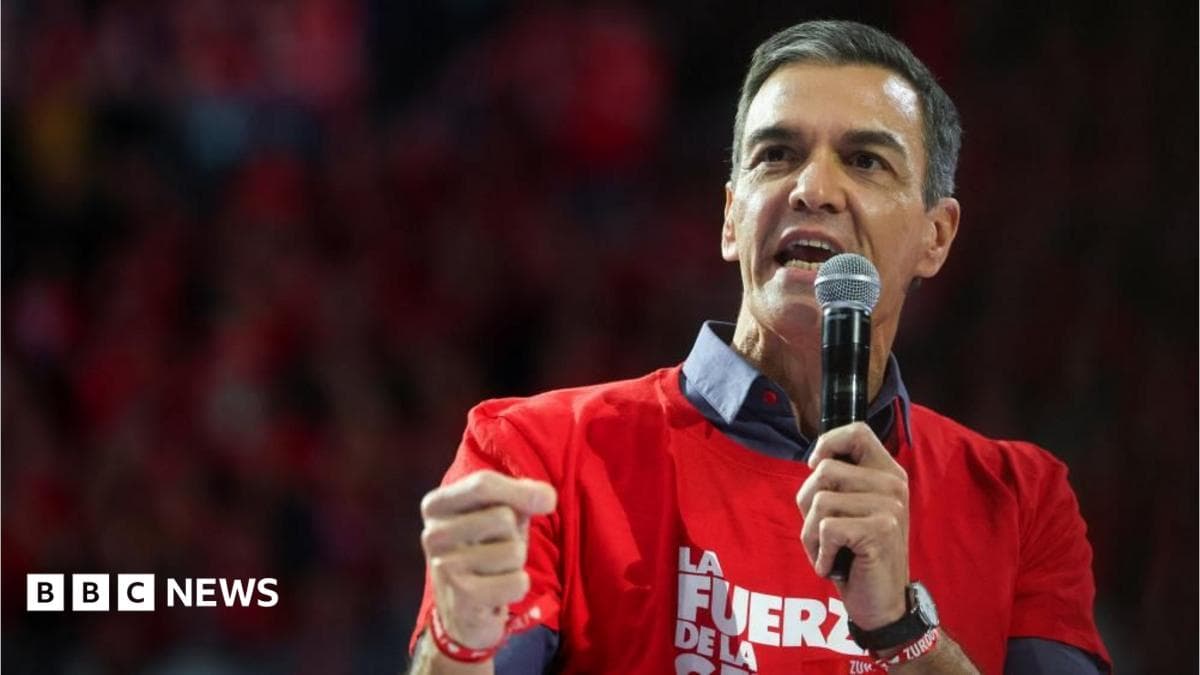
Sánchez took to the stage in Madrid with his wife Begoña Gómez, and donned a red T-shirt that read "power of the people".
He then went on to praise Colau and her left-wing coalition's campaign. As he was speaking, Colau told a large audience in the south of Madrid that not only would they "not remain silent, we will win", vowing to form another "progressive government".