Survivors of Uganda's deadly landslide seek justice at the UN
Survivors reject relocation plans they say ignore their safety, land rights and livelihoods
Noticia publicada originalmente por BBC News — World en bbc.co.uk (se abre en una pestaña nueva). Minuto 24 no es autor de este contenido.
Claves de la noticia
- Supervivientes de un deslizamiento de tierra de 2019 en el este de Uganda, que causó más de 50 muertos, han llevado su reclamación de reubicación y compensación ante la ONU.
- Los 48 demandantes acusan al Gobierno de violar la Constitución de Uganda por no aplicar medidas eficaces de gestión de desastres en Bududa, un distrito montañoso propenso a deslizamientos.
- El Comité de Derechos Humanos de la ONU examina lo que se cree que es el primer caso que busca medidas de adaptación climática, lo que podría sentar un precedente mundial.
- Un nuevo programa de reasentamiento ofrece 18 millones de chelines ugandeses (unos 4.300 dólares) a los hogares afectados, una cantidad que algunos supervivientes consideran insuficiente.
- El Gobierno ha dado a los residentes de zonas de alto riesgo dos meses para marcharse o enfrentarse a un desalojo forzoso.
Contexto
Los deslizamientos de tierra son un riesgo recurrente en zonas montañosas de África Oriental, donde las lluvias intensas pueden provocar tragedias con muchas víctimas. En el caso de Bududa, la mayoría de los fallecidos en 2019 eran niños, lo que ha marcado profundamente a las comunidades afectadas. El caso se enmarca en un debate más amplio sobre quién debe asumir los costes de los efectos del cambio climático, ya que los países con menores emisiones suelen sufrir sus peores consecuencias. Las Naciones Unidas, a través de su Comité de Derechos Humanos, son un organismo internacional que supervisa el cumplimiento de los derechos recogidos en tratados internacionales. El Gobierno ugandés deberá responder a la reclamación en un plazo de seis meses.
Resumen elaborado por Minuto 24 con ayuda de inteligencia artificial a partir de la noticia publicada por BBC News — World. Puede contener imprecisiones: ante cualquier duda, consulta la fuente original.
Published19 November 2026, 09:04 GMT
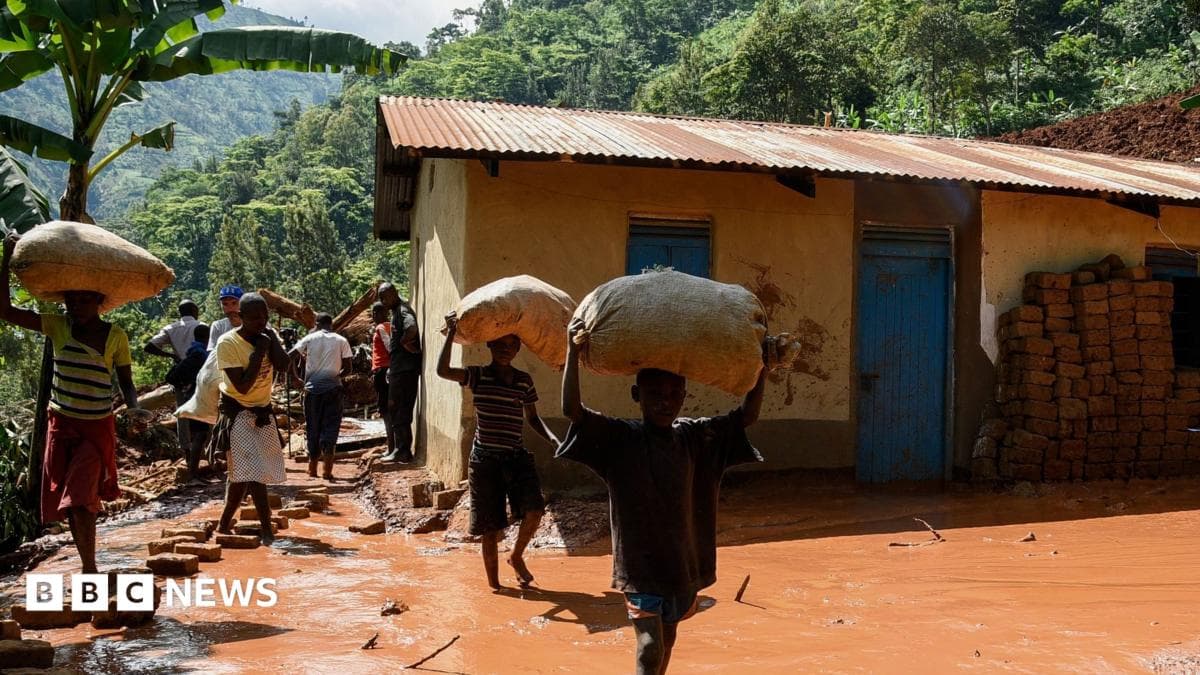
Survivors of a 2019 landslide in eastern Uganda that killed more than 50 people have taken their fight for relocation and compensation to the United Nations.
The 48 complainants accuse the government of violating Uganda's constitution by failing to put effective disaster management measures in Bududa, a mountainous district prone to landslides.
Their case comes as heavy rains raise the risk of further landslides. They say the government relocation programme ignores their safety, land rights and livelihoods.
The UN Human Rights Committee is considering what is believed to be the first case seeking climate adaptation measures, one that could set a global precedent.
At least 33 of the 53 people who died in the 2019 landslide were children. Years later, survivors say every spell of heavy rain brings back fears of another tragedy.
William Tsama, one of the claimants, lost four members of his family.
"My quest should be a lesson," he said.
"Victims in such situations, ignored by governments, can take them to court to compel them to help their citizens."
Uganda introduced a resettlement plan for landslide-prone areas in 2011, but progress has been limited, with relatively few people relocated.
Last month, it launched a new resettlement programme offering affected households 18m Ugandan shillings ($4,300; £3,300) to help them move to safer areas.
But some survivors have questioned whether the amount is enough to cover the cost of relocating and rebuilding their lives.
Under the programme, families can choose between receiving two acres of land, valued at 8m shillings, plus 10m shillings towards building a house, or taking the equivalent land allowance in cash, alongside the same housing grant.
The scheme is expected to benefit 1,410 households identified as living in high-risk areas.
The government has now given residents of designated high-risk areas two months, from November to December, to leave or face forced eviction.
The threat extends beyond landslides. The complainants say changing rainfall patterns and declining soil fertility have also affected farming, leaving many families struggling to secure their livelihoods.
"I want to get a new good place for my people, so even if I die, they will be okay. I am an old man, but I am doing it for my children," Tsama said.
The survivors first launched legal action in 2020 in Uganda, and received support from Ugandan environmental organisation Greenwatch three years later.
They are seeking compensation for lost family members and livelihoods, as well as emergency measures, including accessible early-warning systems in high-risk areas.
Greenwatch Executive Director Samantha Atukunda Kakuru Mwesigwa said the case is about changing how governments prepare and respond to climate-related disasters.
"Justice for claimants is not just about winning in court. It is about forcing government policy to keep pace with a changing climate, and ensuring loss and damage is no longer an afterthought in disaster management," she said.
The threat of climate-related disasters extends across East Africa.
In Kenya, floods and landslides killed at least 181 people between March and May 2024, according to the Kenya Red Cross. In Rwanda, floods and landslides killed 135 people in May 2023.
The dangers are also being felt further afield. In October 2026, a flash flood swept through Nepal's Gorkha district after a landslide blocked a river, washing away homes and infrastructure, and killing over 1,500 people.
"Disasters like the one in Bududa are only getting worse because of climate change – and they are happening all around the world, as we've seen recently and tragically in Nepal," ClientEarth lawyer Vesselina Newman said.
She said poorer countries, which have contributed relatively little to global emissions, are bearing some of the heaviest consequences of climate change and need greater financial support.
"High income countries must provide financial assistance and ensure that sufficient money goes directly to countries like Uganda, so they can roll out life-saving adaptation measures," she said.
The complainants say relocation must involve more than moving people out of danger.
They want the government to protect their livelihoods, respect their land rights, and take account of individual needs.
The case is now before the United Nations Human Rights Committee, which will ask the Ugandan government to respond within six months.
More Uganda stories on BBC:
Arrested generals and a threatened VP: President's son fuels Ugandan succession fever
Wales scraps controversial Uganda tree-planting scheme
Journalist crowned king in Uganda after bitter succession dispute
Go to BBCAfrica.com, external for more news from the African continent.


