This is a remarkable diplomatic moment for China's Xi - but it comes with pitfalls
The meeting comes with challenges as there are things Xi does not appear keen to discuss with Putin and Trump.
Noticia publicada originalmente por BBC News — World en bbc.co.uk (se abre en una pestaña nueva). Minuto 24 no es autor de este contenido.
Claves de la noticia
- China's Xi Jinping hosts a historic summit with Vladimir Putin and Donald Trump in Shenzhen, on the sidelines of an Asia Pacific economic meeting.
- The article argues Xi faces diplomatic pitfalls, as he wants to avoid discussing the war in Ukraine, which is now in its fifth year, to protect ties with Europe.
- Trump wants the three leaders to discuss limiting nuclear weapons, but Beijing has rejected being bound by limits, arguing its arsenal is much smaller than those of the US and Russia.
- The expiry of the New START treaty in February this year has raised fears of an arms race, and China's growing arsenal is causing alarm in Washington.
- Analysts say the meeting is unlikely to produce significant outcomes, but it may help Xi project strength at home ahead of next year's Communist Party Congress, amid economic problems.
Contexto
The meeting matters because it brings together leaders of the United States, Russia and China, the three powers whose choices shape global security and trade. For decades Washington and its Western allies largely set the rules of the international order, so China hosting such a gathering signals its growing influence. The war in Ukraine, Russia's full-scale invasion of its neighbour, remains the main source of tension between Moscow and Western capitals. Nuclear arms control is also in flux after the expiry of New START, the last major agreement between the United States and Russia limiting their arsenals. Meanwhile, China faces a property crisis, slowing manufacturing and youth unemployment, which give the summit a domestic dimension as Xi prepares for a party congress.
Resumen elaborado por Minuto 24 con ayuda de inteligencia artificial a partir de la noticia publicada por BBC News — World. Puede contener imprecisiones: ante cualquier duda, consulta la fuente original.
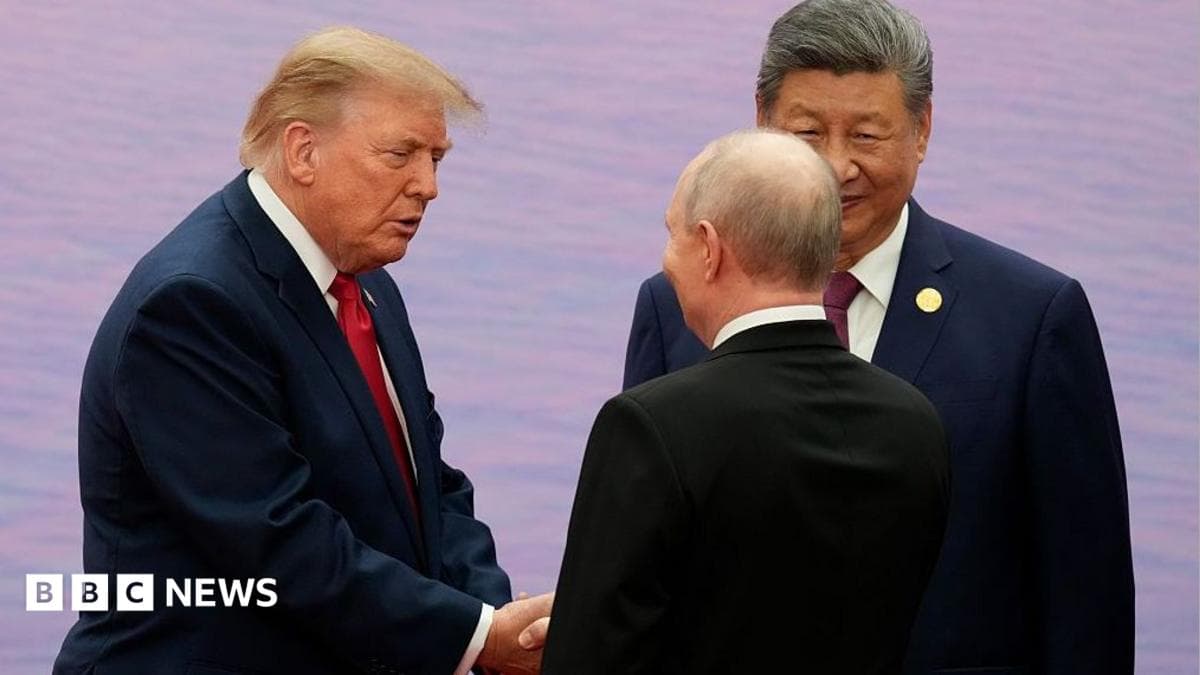
Xi Jinping will believe he has achieved something no other world leader could in securing a historic summit with Vladimir Putin and Donald Trump in Shenzhen.
For decades, Washington and its western allies shaped the world order.
Yet it is China that has orchestrated the remarkable diplomatic spectacle of three of the world's most powerful protagonists sitting around the table.
And surrounding it all is the futuristic display that is Shenzhen, with driverless cars cruising past as drones fly overhead and robots - literally - dance in the streets.
Ostensibly, this is an economic summit for Asia Pacific leaders. But for Xi, it is also a demonstration of China's grip on the global economy and world politics.
His country is no longer just reacting to decisions made in Washington, London or Brussels - instead Beijing is at the heart of conversations which are reshaping the international order.
But this meeting is not without its pitfalls for Xi as there are many things he does not appear keen to discuss with Putin and Trump.
Follow live updates: Trump, Xi and Putin hold historic meeting on Apec sidelines
Ukraine, the balancing act
First, China is not keen for the war in Ukraine, now well into its fifth year, to be on the agenda.
This is a delicate balancing act for Xi who is aware his relationship with Putin may damage China's connections in Europe. The EU is a key market, especially now when the Chinese economy is heavily relying on exports.
However Xi also doesn't want the war to end in a way that will destabilise Russia, a key ally and neighbour.
Beijing is still trying to maintain that it is neutral in this war and has repeatedly called for negotiations and a political settlement while avoiding condemnation of Russia's full-scale invasion.
The US, especially under the previous Biden administration, and Europe have accused China of sending Russia components that it could use in its war in Ukraine, while also propping up the country's economy by buying oil and gas.
Xi wants to keep Putin close, but not too close because he also doesn't want Russia's problems to become China's problems.
China's growing nuclear arsenal
Donald Trump has already made it clear he wants the three leaders to discuss limiting the world's supply of nuclear weapons.
The US and Russia possess the world's largest stockpile of nuclear warheads. But China is rapidly expanding its own arsenal, which is raising alarm bells in Washington.
The last major US-Russian arms control treaty, known as New START, expired in February this year, triggering fears of an arms race. The agreement had set a cap to control the number of nuclear weapons in US and Russia's arsenal.
Trump would like China to be included in any new agreement, but Beijing has pushed back.
Xi's argument will be that his arsenal is considerably smaller than what Washington and Moscow own, and, therefore, it would be unfair for Beijing to be bound by their limits. China also believes it should have the freedom to develop its own nuclear capabilities.
This subject could complicate Xi's bid for China to be recognised as a leader on the world stage - because the US could argue that the status includes being a responsible nuclear power.
Will everyone stick to the script?
Xi will want to control the optics of this meeting, from start to finish.
Chinese officials like to nail down agendas with talking points and produce carefully choreographed speeches.
But in this unprecedented summit, Xi will have to live with two very unpredictable leaders.
Both Trump and Putin have their own agendas and the US President has already threatened to go off script.
There is a risk that they both dominate the meeting and Xi ends up looking like a host, rather than the architect of a major diplomatic moment.
Of course, Xi may be ready for this. It may even play into his hands.
The Chinese leader has been trying to portray himself as a stable global leader - at this summit he will be flanked by two men embroiled in wars they cannot seem to end.
So any unscripted moment could serve to highlight his preferred role as senior statesman.
Xi's problems at home
For all the attention, this meeting of three men with vastly different agendas is unlikely to yield any significant outcomes.
But the power it projects is important for Xi as he heads towards next year's Communist Party Congress, where he is expected to secure a historic fourth term as leader of the party and country.
He may hope to use this as propaganda at home, given the country is grappling with huge domestic challenges.
A country-wide property crisis has dented consumer confidence. Local governments are heavily in debt. Manufacturing has slowed and more of China's workforce has become dependent on flexible jobs with no pension or social security. One in five young people are thought to be struggling to find work. Frustration and anxiety about the future bubble up routinely.
Xi does not have to deal with elections, and the country has not seen major protests in decades. But he will be concerned about his popularity within the party elite as these problems - and the palpable frustrations they produce - grow.
At a time like this, a photo-op with Putin and Trump may offer him proof that his country's "century of humiliation" is over. China is no longer a rising power, he can argue - rather, it is increasingly shaping the rules of a new era.