Massive hope for pancreatic cancer pill after trial saw tumours vanish
Daily pill daraxonrasib appears to shrink and possibly even eliminate tumours in some patients with one of the deadliest cancers.
Noticia publicada originalmente por BBC News — World en bbc.co.uk (se abre en una pestaña nueva). Minuto 24 no es autor de este contenido.
Claves de la noticia
- Un nuevo fármaco oral diario, daraxonrasib, administrado junto con quimioterapia, mostró en ensayos tempranos la desaparición de tumores en algunos pacientes con cáncer de páncreas.
- En torno a uno de cada 12 pacientes, el cáncer dejó de ser detectable en las tomografías computarizadas (TC).
- Los tumores dejaron de crecer en casi todos los 61 participantes con cáncer avanzado de páncreas recién diagnosticado que se había extendido.
- Los médicos advierten que aún no se sabe cuánto tiempo puede contener la enfermedad y que el tratamiento no debe considerarse una cura.
- Dr. Wungki Park, del Memorial Sloan Kettering, afirmó que los resultados son muy alentadores y podrían traducirse en mayor supervivencia.
Contexto
El cáncer de páncreas es uno de los tipos más letales y difíciles de tratar, y tiene la tasa de supervivencia más baja entre los cánceres comunes en Reino Unido. La quimioterapia suele reducir los tumores solo ligeramente y la enfermedad a menudo reaparece. Por ello, cualquier avance se considera importante. El fármaco ya está aprobado en Estados Unidos y actúa sobre mutaciones RAS, presentes en la mayoría de estos tumores. Los resultados se presentaron en un congreso europeo de oncología, y los expertos subrayan que se necesitan estudios más largos para saber si los efectos se mantienen en el tiempo.
Resumen elaborado por Minuto 24 con ayuda de inteligencia artificial a partir de la noticia publicada por BBC News — World. Puede contener imprecisiones: ante cualquier duda, consulta la fuente original.
Published20 November 2026, 00:08 GMT
Experts are calling it the biggest breakthrough in pancreatic cancer treatment for decades - a daily pill that appears to shrink and possibly even eliminate tumours in some patients with one of the deadliest and hardest-to-treat cancers.
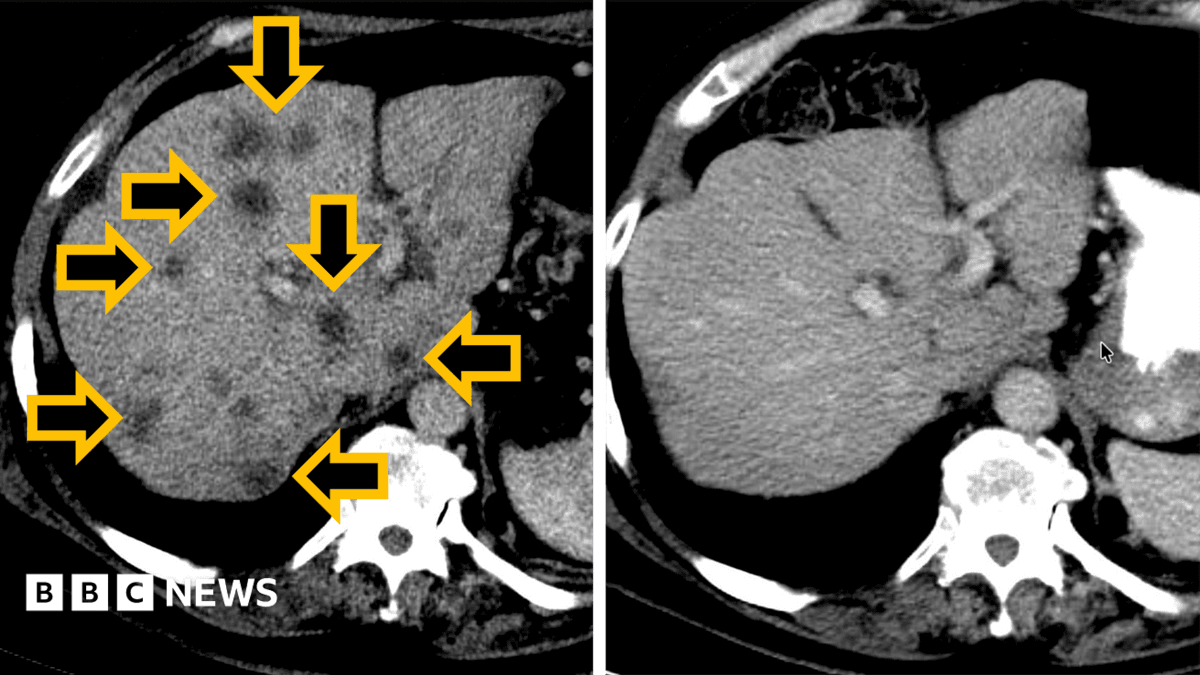
Cancer became undetectable on scans in one in 12 of the patients given daraxonrasib along with chemotherapy in early medical trials.
Tumours stopped growing in almost all of the 61 participants who had recently been diagnosed with advanced pancreatic cancer that had spread to other parts of the body.
But doctors stress it is unclear how long it might keep the disease at bay and should not be seen as a cure.
Incredibly exciting
Cancer Research UK called it "the biggest leap forward in decades" for pancreatic cancer patients.
The charity's Dr Sam Godfrey told BBC News that the results were incredibly exciting. "What this new drug has done is it's found a way of drugging the undruggable.
"We are finally seeing progress in pancreatic cancer which is so long overdue."
Pancreatic cancer is notoriously hard to treat and has the lowest survival rate of all common cancers in the UK.
Although chemotherapy can shrink tumours a bit, the cancer often grows again.
Most patients with advanced disease survive months, not years.
Doctors hope the new treatment might offer patients more time, even if it cannot stop cancers for good.
The trial followed patients for a year and a half, on average, and some did not see their cancer return during this time.
Longer studies are needed to understand if any of these cancers can be put into remission and for how long.
tumours stopped growing in 90% of patients
just over 60% of patients saw their tumours shrink or disappear
for around 8% of patients, or one in 12, tumours became undetectable on CT scans
Longer survival
Dr Wungki Park, from Memorial Sloan Kettering Cancer Center in the US and who is involved in the trial, said the results were extremely encouraging so far.
"We are beginning to see not only a higher percentage of tumour response rates, but also deeper responses and a near doubling in the duration of disease control, which may eventually translate into longer survival," he said.
Daraxonrasib is a targeted inhibitor treatment that has already been approved in the US. It works by locking on to and shutting off certain mutations, called RAS, external, found in most pancreatic cancers that drive tumour growth.
Dozens of other cancers, including lung and ovarian, can have similar mutations, meaning the drug might help lots of other patients too.
Dr Godfrey said: "I would hope that the early success that we are beginning to see in pancreatic cancer can also be rolled out to other cancers."
He said longer trials and results were vital. "Cancer can come back and even if scans show there is no sign of it, you don't necessarily know you are cancer-free until more time has passed."
Prof Elena Garralda, chair of a European cancer conference called EORTC–NCI–AACR Symposium 2026, external where the work is being presented to other doctors, said: "These results are exciting because they show the combined treatment could potentially significantly improve patients' overall survival, as well as the time before tumours start to grow again."
Pancreatic cancer accounts for about 3% of all cancers in the United States and about 8% of all cancer deaths, killing around 53,000 people a year, external.
In Britain, there are 11,500 diagnoses of the disease each year and around 10,200 deaths, according to Cancer Research UK.
Actor Alan Rickman died of the disease in 2016, five months after diagnosis.
Symptoms can include, external jaundice, itchy skin, darker pee, paler poo, unexplained weight loss, tiredness and high temperature.
Get in touch
Do you have any questions about the issues raised in this story, or have you been affected by them?