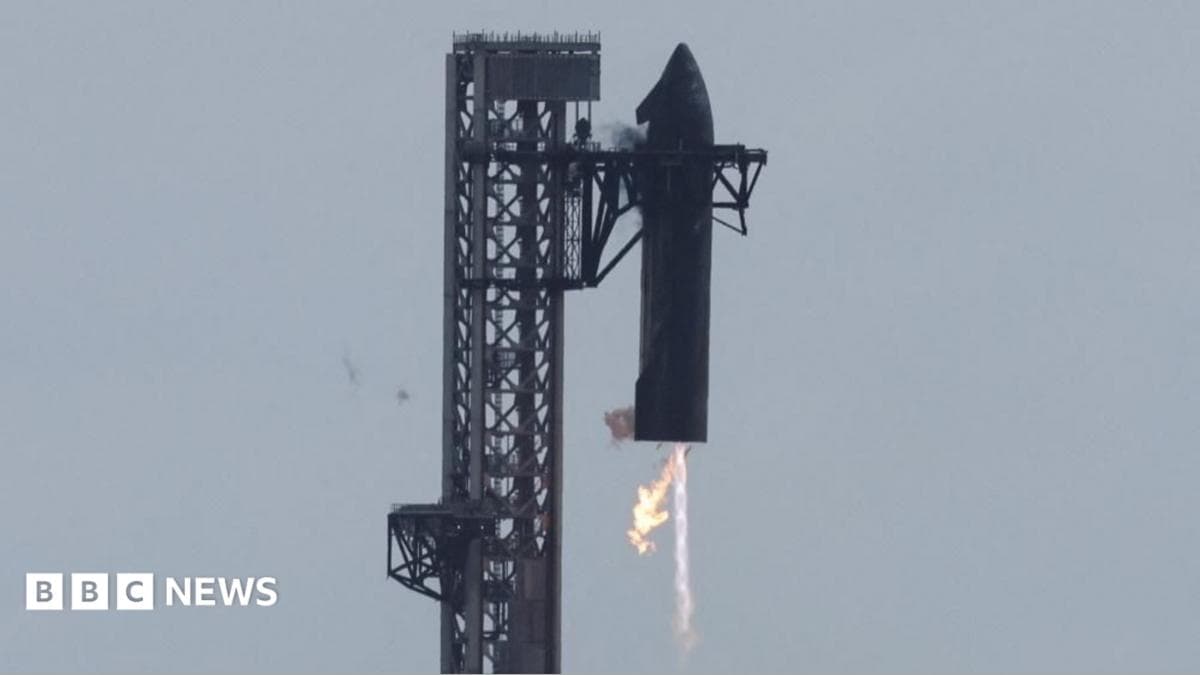
SpaceX successfully catches Starship and makes history
The company's spacecraft returned to its Texas launchpad in dramatic fashion — by carefully lowering itself until two metal arms attached to the launch tower could secure it.
Noticia publicada originalmente por NPR — News en npr.org (se abre en una pestaña nueva). Minuto 24 no es autor de este contenido.
Claves de la noticia
- La nave Starship de SpaceX regresó a la plataforma de lanzamiento en Texas el sábado, al ser atrapada en el aire por grandes brazos mecánicos, 22 horas después de despegar.
- Fue la primera captura de una Starship que vuelve del espacio, aunque el propulsor principal explotó poco después del despegue y no logró la doble captura prevista.
- La nave completó 14 vueltas alrededor de la Tierra a unos 265 kilómetros de altura y liberó 26 satélites Starlink tras separarse del propulsor.
- SpaceX afirma que todos los sistemas de la nave, incluido su escudo térmico, parecieron funcionar bien; los ingenieros investigan por qué el propulsor se apagó demasiado pronto.
- La NASA recibió la noticia con agrado, ya que depende de Starship para llevar astronautas de Artemis a la Luna.
Contexto
Starship es el cohete más grande y potente del mundo, y SpaceX lo desarrolla para viajes a la Luna y a Marte. Su reutilización completa es clave para reducir costes y hacer posibles misiones frecuentes. La NASA le ha encargado el alunizaje de sus astronautas del programa Artemis, previsto para finales de esta década, por lo que cada avance técnico influye en los calendarios de la agencia. El ambicioso plan de Elon Musk incluye además construir una ciudad en Marte. Por ello, el éxito parcial de este vuelo es un paso relevante, aunque el fallo del propulsor muestra que la tecnología aún necesita pruebas adicionales.
Resumen elaborado por Minuto 24 con ayuda de inteligencia artificial a partir de la noticia publicada por NPR — News. Puede contener imprecisiones: ante cualquier duda, consulta la fuente original.

SpaceX's mega rocket Starship lifts off for a test flight from Starbase, Texas, on Friday. Eric Gay/AP hide caption
CAPE CANAVERAL, Fla. — SpaceX's Starship made a triumphant return to Earth on Saturday, caught in midair by giant mechanical arms where its journey began 22 hours earlier.
It was the grand finale that Elon Musk and his team hoped for — the first-ever capture of a Starship flying back from space. But with the first-stage booster exploding shortly after Friday's liftoff from Texas, the company fell short of its desired double catch.
Wreckage remained in the Gulf of Mexico, cordoned off by buoys, as the stainless steel, bullet-shaped spacecraft lowered itself upright at the launch pad.
The dramatic, sci-fi-like capture helped blot out the booster's messy miss.
"Can you believe it?" shouted SpaceX commentator Dan Huot.
SpaceX officials said Saturday's catch demonstrates the full reusability of Starship, intended for moon and Mars travel. Although Friday's booster recovery failed, the company had already made three previous booster catches, validating the technique.
NASA welcomed Saturday's news. The space agency is paying billions of dollars for Starship to land Artemis astronauts on the moon later this decade and help build a permanent lunar base. Musk's ambitions are even grander: He wants to launch a fleet of Starships to build a city on Mars.
The world's largest and most powerful rocket — a 407-foot (124-meter) behemoth — blasted off late Friday afternoon from SpaceX's Starship base near the U.S.-Mexican border. Separating neatly from its booster before things went awry, the upper-stage spacecraft soared into orbit and released 26 advanced Starlink satellites.
Starship continued circling the world 165 miles (265 kilometers) up, with live views of itself and Earth streaming down via Starlink. The spacecraft completed 14 laps around Earth, outshining the previous mission's one to two laps.
It was SpaceX's 15th flight of a full-scale Starship since 2023 and its only second trip to orbit.
SpaceX reported that everything on the spacecraft, including its vital heat shield, appeared to work well.
As for the booster, SpaceX's Kate Tice said its engines stopped firing too soon on the way back down. The booster's guidance system sensed it wasn't in the right position and automatically initiated the watery detour and self-destruction. Engineers are still investigating the cause.
SpaceX expects to begin launching Starships from Florida's Kennedy Space Center within the next few months. That is the starting point for NASA's next Artemis mission, which will skip the moon and remain in orbit around Earth for lunar lander practice.
Artemis III's four astronauts will attempt to dock their capsule with not only Starship but Blue Origin's Blue Moon. The two companies will take turns delivering crews to the lunar surface. NASA is targeting as soon as 2028 for Artemis IV, humanity's first moon landing since the Apollo era more than half a century ago.
NPR does not offer or accept money for coverage or interviews. Anyone who makes such an offer or request is not an NPR employee and does not represent NPR.