Trump posthumously pardons US baseball legend Pete Rose
Rose, who died in 2024, was given a lifetime ban from the sport for betting on games but was reinstated last year.
Noticia publicada originalmente por BBC News — World en bbc.co.uk (se abre en una pestaña nueva). Minuto 24 no es autor de este contenido.
Claves de la noticia
- El presidente Donald Trump concedió un indulto total y póstumo al exjugador de béisbol Pete Rose, anunciado en Truth Social.
- Rose, fallecido en 2024 a los 83 años, se declaró culpable en 1990 de dos cargos por presentar declaraciones de impuestos falsas.
- Rose recibió una suspensión de por vida de las Grandes Ligas tras una investigación que reveló que había apostado en partidos.
- Rose tiene el récord de 4.256 hits en su carrera, más que cualquier otro jugador, y fue rehabilitado póstumamente por la MLB el año pasado.
- Según el artículo, el indulto es en gran medida simbólico y no altera el estatus de Rose en el Salón de la Fama del béisbol.
Contexto
Pete Rose es una de las figuras más conocidas del béisbol estadounidense, apodado 'Charlie Hustle', y su caso ha sido objeto de debate durante décadas. El indulto presidencial es una facultad que otorga la Constitución de Estados Unidos al presidente para perdonar delitos federales, aunque en este caso se concedió después de la muerte del beneficiario. La decisión se suma a un historial de declaraciones públicas de Trump sobre Rose, a quien había defendido desde 2025 para que fuera incluido en el Salón de la Fama. El Departamento de Justicia no suele tramitar solicitudes de indulto póstumo, y la BBC indicó que había contactado con el Salón de la Fama y con el Departamento de Justicia para recabar comentarios.
Resumen elaborado por Minuto 24 con ayuda de inteligencia artificial a partir de la noticia publicada por BBC News — World. Puede contener imprecisiones: ante cualquier duda, consulta la fuente original.
Published19 November 2026
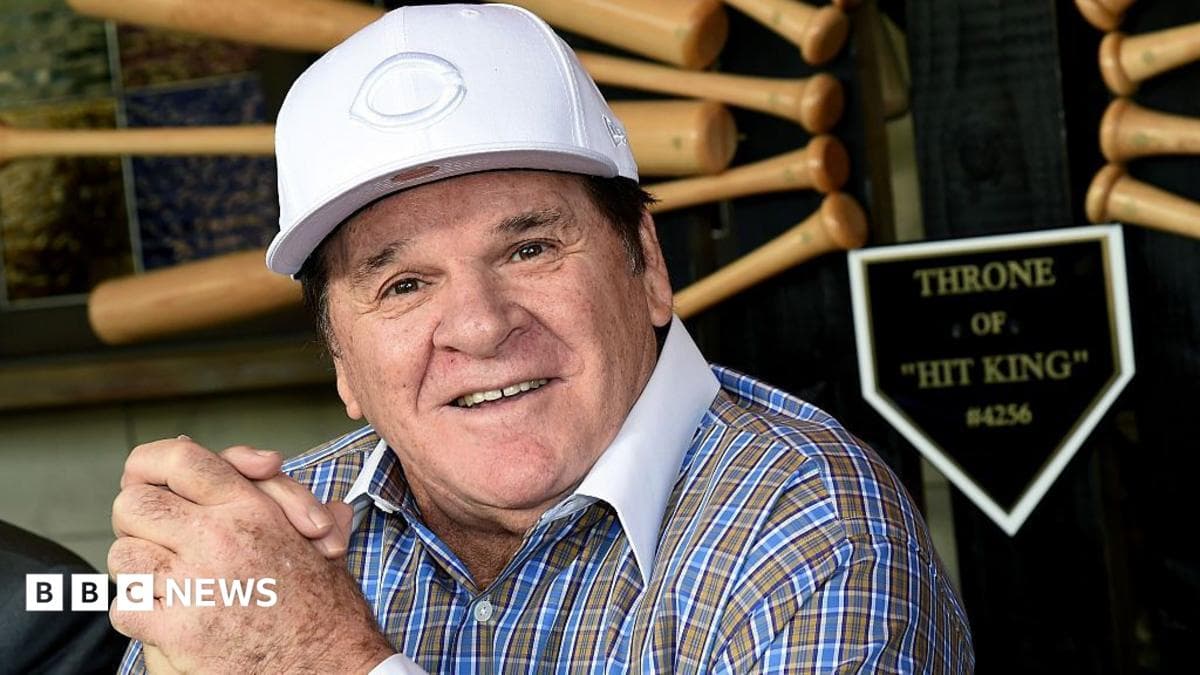
US President Donald Trump has posthumously pardoned baseball legend Pete Rose.
"I have just given a Complete and Total Pardon to the Late, Great Pete Rose, a true Baseball SUPERSTAR & LEGEND," Trump wrote on Truth Social on Thursday.
Rose, who died in 2024 at the age of 83, pleaded guilty in 1990 to two counts of filing false tax returns. He was also given a lifetime ban from Major League Baseball (MLB) after an investigation revealed he bet on games.
The baseball star was posthumously reinstated to MLB, in which he played for 24 seasons, last year and made eligible for the Baseball Hall of Fame.
Trump also said on Thursday that Rose's "record of 4,256 Hits in a Season will never be broken".
In fact, Rose accumulated a record 4,256 hits - which MLB defines as a batter striking the baseball into fair territory and reaching base without doing so via an error or a fielder's choice - during his career, which is more than any other player. He played a total of 3,562 games.
According to Trump, Rose "was treated terribly by Major League Baseball in not allowing him to go into the Baseball Hall of Fame. Politics, I guess".
The US Constitution gives a sitting president the broad power to grant a pardon, which represents legal forgiveness and ends any further punishment.
Because Rose's pardon was issued after his death, it is largely symbolic and does not change Rose's Hall of Fame status. The Department of Justice (DoJ) typically does not process posthumous pardon applications, though presidents have still issued them.
The BBC has contacted the Hall of Fame and the DoJ for comment.
The US president had previously floated the idea of pardoning Rose in March last year before the MLB reinstated him.
"Major League Baseball didn't have the courage or decency to put the late, great, Pete Rose, also known as 'Charlie Hustle,' into the Baseball Hall of fame," he wrote on Truth Social at the time.
"Now he is dead, will never experience the thrill of being selected, even though he was a FAR BETTER PLAYER than most of those who made it, and can only be named posthumously. WHAT A SHAME," Trump added.
MLB Commissioner Rob Manfred issued a decision in May 2025 that created a pathway for Rose to be eligible to be inducted into the baseball Hall of Fame - a ruling that also applied to 16 other people - as early as 2028.
In August 1989, Rose agreed to the permanent ban from the sport after MLB investigators found that he bet on his team, the Cincinnati Reds, multiple times while he was playing on and managing the team from 1985 to 1987.
In July 1990, after Rose admitted to failing to report $354,968 (£271,107) in income over a four-year period, he was sentenced to five months in prison. He also was fined $50,000 and ordered to perform community service at the time.


